The Essential Guide To Military FOD Prevention
Protecting Military Aircraft From Foreign Object Damage
Anyone who has spent time working in the military around aircraft has heard about Foreign Object Debris and Foreign Object Damage. Military organizations enforce exacting FOD prevention controls over both their personnel and their work procedures. Given this level of discipline, it is therefore sometimes difficult to understand how their aircraft continue to suffer from damage caused by FOD.
 Ground crews keep work areas scrupulously clean and well maintained. Maintainers keep tools in good condition and rigorously control them. In fact, personnel receive specific training and regular refreshers on the hazards of FOD. Even those not associated with aircraft operations must remain vigilant.
So why then have three nations this author has direct knowledge of lost military aircraft in the last ten years from FOD to fan or compressor blades on turbine engines?
It is not enough to understand just what FOD is. We also need to understand how it occurs. We must identify the specific hazards unique to each work area and develop tailored prevention activities that aim to eliminate military FOD.
Understanding military FOD is the first important step we must take before enforcing relatively simple and routine preventative measures. Indeed, understanding the mechanisms of FOD establishes the first and vital foundation block. From there, we can build a prevention program to minimize the operational, economic, and human costs of FOD.
Getting Started
Indeed, FOD means different things to different people and can show itself in many ways on an aircraft and its components.
FOD Is A Threat To Aircraft Tires
When an aircraft taxis down a runway, the tires may pass over a stone or sharp object. Consequently, this can cut the tread and lead to subsequent failure. The puncture may occur immediately or, more likely, when the tire is rotated and loaded on takeoff.
One of the most notable FOD incidents occurred on July 25th, 2001. A French Concorde, Flight AF4590, was taking off from Paris. The aircraft reportedly taxied over a piece of metal shed by another aircraft. A main undercarriage tire was cut. The subsequent failure on takeoff shed a large piece of tread. It struck the wing and caused a hydraulic shock wave in the fuel tank.
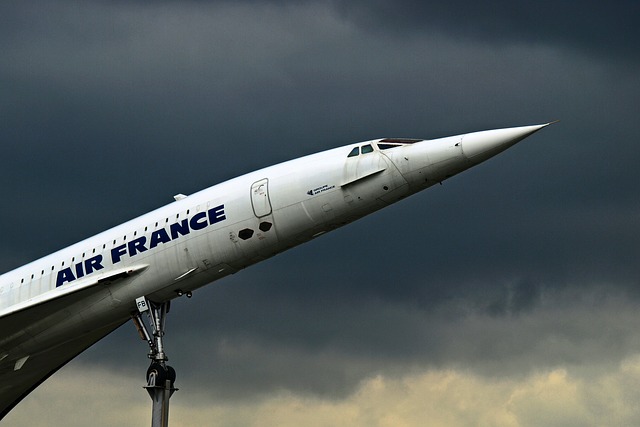 As a result, a massive fuel leak ensued. It was ignited by an electrical arc from wiring in the undercarriage. The tire failure had damaged that wiring. Further damage struck the hydraulic pipes and controls. Consequently, the undercarriage could not retract. The number one engine lost power, and the second engine cut out. At this stage it was too late to abort the take off.
In the critical first moments of flight, the crew fought to overcome the high drag of the supersonic airframe. The aircraft was unable to gain height or speed. Fire engulfed the wing, engines, and flying surfaces. The aircraft flew for less than three minutes. It crashed into a hotel in the small town of Gonesse, killing 109 on board and four on the ground.
Aircraft Tires Are Exposed To Extreme Forces
Whilst the tire loading on take off is high, especially at the Concorde’s very high take off speed — about 250 miles per hour compared with 170 miles per hour for most other subsonic aircraft — that loading is magnified many times over on landing.
On landing, the descending weight of the aircraft shock loads the wheel. Additionally, it must handle instantaneous acceleration to well over 100 miles per hour. As a result, a burst at this critical moment can lead to sudden loss of control and force the aircraft off the runway.
Burst Tires Lead To Loss Of Aircraft Control
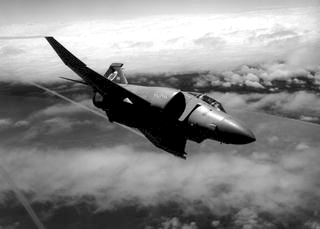
Early in my career, I was on a detachment at RAF Waddington, near Lincoln, England, when an F4 Phantom blew a tire on landing. The aircraft immediately departed the runway, ran onto the grass in the center of the airfield, and sped toward cabins where the ground crew and I were operating.
The pilot fought with the controls. However, as the aircraft sank into the muddy field, he was unable to adequately retard the speed. More importantly, he could not steer the nose wheels to control the direction. At less than five hundred yards from the buildings, the pilot was faced with a split-second decision, and he and his navigator ejected.
The aircraft carried on its path, held firmly in its mud tracks. As it continued to sink up to its axles and landing gear doors, its speed rapidly declined. It came to rest a few hundred yards short of the buildings. Several seconds later the pilot and navigator, both now under parachute, landed safely on the airfield.
Fortunately, no one suffered injury. It is an event that I will never forget. It has served as a lasting reminder of the hazards of aircraft operations and of FOD.
FOD Is A Threat To Turbine Engines
For the uninitiated, turbine engines can rotate at over ten thousand-rpm, and when a tiny piece of debris like a piece of safety locking wire or stone get ingested it behaves in a ballistic manner, striking the compressor blades as if fired from a gun. Depending on material grade, shape, and size, the debris can damage the first blade or any part of the intake it strikes.
As the debris passes through the engine, contact with fan blades can break it into smaller chunks. Alternatively, it can liberate pieces from the blades themselves. Consequently, this multiplies the debris field and increases both the size and quantity of the damage.
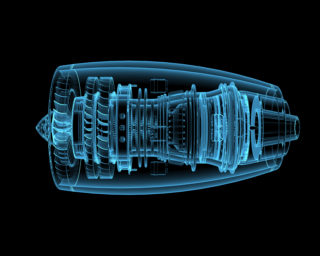 I have seen a small nick on the first stage of the fan. Meanwhile, the rear stages of the compressor and most of the turbine rotors were completely decimated. It looked as if someone had taken barber shears and clipped the blades from the disk. Highly loaded blades — or those subject to vibration — face additional risk. This is sometimes referred to as HCF (High Cycle Fatigue). In these cases, damage can grow rapidly into a crack and ultimately cause blade failure.
Catastrophic Engine Damage
Engineers design engines to contain failed blades. Nevertheless, a blade failure can lead to the total destruction of the engine. Indeed, many posters illustrate this point clearly. The ingestion of a small metal screw — costing just a few pennies — can cause damage requiring complete engine replacement. Ultimately, that replacement costs many millions of dollars.
However, it is not just hard debris that causes damage. A plastic bag can behave like a large sheet and blank the intake. This stalls the airflow across the blades and causes the engine to surge. Engines can usually tolerate a surge — a reversal of the airflow. However, depending on severity, a surge can deform blades and necessitate engine replacement.
Foreign Object Elimination Is Our Mission
It is easy to see why we must control debris to maintain safety and reduce costs. FOD represents a genuine flight safety risk. Everyone bears responsibility for keeping that risk as low as possible.
Picking up debris that could migrate onto airfields is the first step that could avert a disaster.
True, seldom does FOD result in a disaster. However, it can be one link in a chain of events. If left unbroken, that chain could result in engine failure, loss of aircraft, and loss of life. Breaking that chain can be as simple as picking up litter. Above all, training and education offer the greatest return on effort. More can be done by targeting specific areas for improvement. Coordinating increasingly limited resources helps reduce problems and deliver the best return on investment.
Sources and Mechanisms of FOD
Understanding how engines ingest debris is important.
Vortex Ingestion
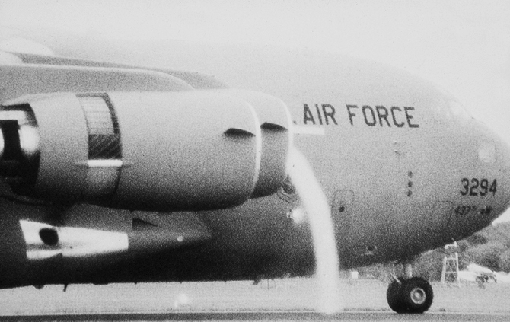
Engines ingest debris through vortex ingestion. You can sometimes observe this phenomenon during cold, wet conditions when water rises into the vortex.
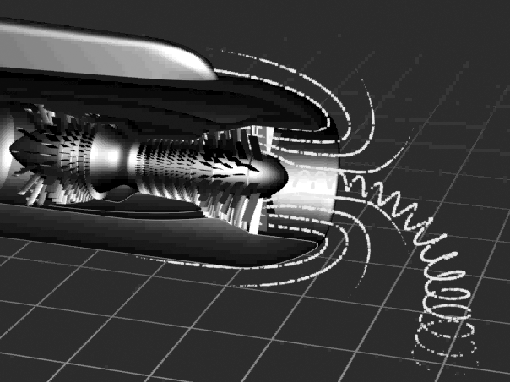
Airflow disturbance around the intake mouth creates a vortex. In normal conditions, airflow enters from all around the intake. As airflow enters from the rear of the intake, it interacts with the ground plane. The ground and the underbelly of the aircraft create a Venturi Vacuum Effect. A vortex initiates when a prevailing wind blows at an angle to the intake face. In turn, this forms a shear vector that causes the airflow-to-ground-plane interaction to swirl.
A vortex seen on a Boeing C17 Globemaster
Vortex air flow illustration
The speed and strength of a vortex depend on the ingested airflow and wind vector. Preventing a vortex from forming can be as simple as pointing the aircraft into wind.
When a vortex forms and attaches to the ground, the periphery behaves like a rotating brush sweeping objects out of its path. However, objects trapped between gaps in the concrete face a different fate. If the eye of the vortex passes over them, the negative pressure can pick them up and ingest them.
Therefore, crews must pay special attention to cleaning these gaps. Fill them completely with sealant. Essentially, this eliminates temporary resting places for debris.
Want to learn more? Contact us for guidance on developing your FOD prevention program!
Aircraft Generated FOD
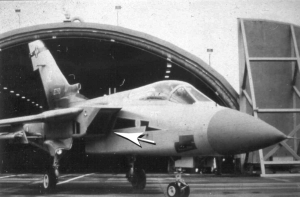
Aircraft-generated debris is especially noticeable on supersonic intakes with auxiliary air intake doors. Specifically, these doors supplement the intake airflow when the aircraft is stationary or at slow forward speed. At high speeds, they vent air when the intake is in ram effect.
Older supersonic intakes have many moving parts — ramps and doors. Movable ramps form shock waves to slow the airflow in supersonic flight. Meanwhile, air bleeding systems present the engine with smooth, controlled airflow at the right speed. The ramps and some doors are usually hydraulically operated. In turn, they are supported by mechanical components and switches. These, in turn, have their own access doors, hatches, and fairings. Various fasteners and locking devices secure the access doors. These fasteners and locking devices have proven to be frequent causes of FOD.
Secondary Inspection
Special FOD prevention measures can be put in place after any work involving panel removal. These measures call for an independent inspection by an unconnected third-party tradesperson. The inspector checks for fit, form, and function — as is usual with an independent inspection. Crucially, they also ensure that the panel and its fasteners do not become a debris hazard.
Furthermore, consider cleaning and checking any access bays before closing them. This can be as simple as using a vacuum and a flashlight. Furthermore, teams can apply additional security measures inexpensively. For years, the military has used fastener bags when removing panels. Loose fasteners go into the bag. The technician then attaches the bag to the panel on the parts stand.
Remember: what may seem obvious to the trained eye must be learned by newcomers. We should share experience rather than make the uninitiated learn the lesson again. This matters especially where safety is at stake.
The Tornado auxiliary air intake doors are shown adjacent to the intake, under the leading edge of the wing where the wing joins the fuselage.
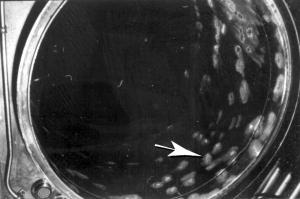
Tornado intake viewed from the engine bay looking forward to the air intake lip. The white blemishes show damage that has been dressed out.
Thrust Reverse
Perhaps the prime contributor to FOD on fast jets is thrust reverse. Essentially, this system directs engine exhaust air forward to provide a braking mechanism. Thrust reverse disturbs the smooth airflow around the intake and ground. It can pick up debris and project particles into the strong airflow around the intake lip. From there, particles travel down the intake and into the engine.
Many airlines also use thrust reverse to help control speed on landing and prevent the aircraft brakes from overheating. Operators must strictly control the use of thrust reverse. They should limit it to forward airspeeds where particles cannot reach the intake. Even at slow forward speed, the hot exhaust gas can be re-ingested. This in turn causes engine stall and surge.
Human Generated
History has proven that human-generated debris is a main contributor to FOD.
Unfortunately, intakes and intake lips do provide a convenient resting place for temporarily storing articles. Whether high or low set, crews must check and recheck intakes before every engine start.
RAF Phantom F4 from 74 Squadron
Engine Intakes Are An Ongoing Risk
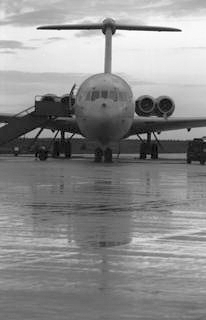
On the VC10 transport aircraft, the intakes are simple bell-mouth shapes. They form part of the pods that house the engines. Two sit on each side of the tail, about 12 feet off the ground.
During intake maintenance, a technician applied a small pot of rubberized sealing agent to the outboard intake. He used the inner intake as a stand for the pot. Again, the work person was distracted and the pot was forgotten.
During the subsequent pre-flight inspection, crew checked the intake from the ground. However, because of the height, the intake lip made the pot invisible to both aircrew and ground crew. On engine startup, the fan drew the pot into its face. It severely damaged the engine, leading to its replacement and overhaul.
It Only Takes A Momentary Distraction
Distractions like the ones above are common in aircraft operations. Even the most capable personnel can be forgetful. Indeed, multiple tasks and a decreasing timeline compound the risk.
Accordingly, the military brought tool control into effect. The control of C stores — screws, bolts, seals, and washers — was implemented alongside it. The tool control section below covers this in detail.
Maintainers undergo refresher training to keep the dangers of FOD fresh in their memories. However, many visitors to aircraft operating bases will not have come across the acronym. They may not understand the associated hazards. Strangely, many contractors with access to aircraft work areas may never get briefed.
Fortunately, the military in the USA and UK generally recognize this loophole. They provide briefings and instructions to contractors working on their units. Moreover, each station has a FOD Prevention Officer who understands engine maintenance and has the ear of command. A nominated prevention officer serves the whole service. This command structure provides visibility and drives action to prevent recurrence of incidents.
Coveralls Required
Lastly, regarding human-generated FOD: the Royal Air Force insists that aircrew and ground crew keep their pockets free from objects. Accordingly, working coveralls have no buttons. The service provides personal lockers — secured with combination locks — for clothing and small items like keys and money.
In some areas, such as the flightline, additional small personal item lockers — similar to lockable mailboxes — are available to secure frequently used small items. In addition, smoking is prohibited in all work areas. For engine intake inspections — where the inspector enters the intake — many bases issue special pocket-less coveralls.
Debris Control
Understanding the mechanisms of ingestion helps visualize how debris gets ingested. In particular, this knowledge is essential for generating effective working practices.
Personnel must keep all work areas scrupulously clean. Maintenance teams must quickly repair any breakdown in paved surfaces. If possible, isolate and cordon off the damage. In addition, clean and check it regularly to ensure particles are not accumulating. During repairs, debris can become a problem. Therefore, brief all work personnel thoroughly. Check the area as the repair progresses. In recent years, crews have placed plastic mesh barriers around work sites to prevent debris migration. Moreover, the mesh is typically bright orange. This provides a clear visual warning to avoid the area.
On many bases, civilian contractors carry out repairs. Brief them about the dangers of uncontained debris without exception.
Contractors Should Be Advised Of The Risks And Supervised
Concrete runways are routinely overhauled. After many landings, crews must remove rubber tire marks. On one Air Force Base, a civilian contractor carried out this operation over a weekend. Nobody probably briefed or supervised the contractor. They used metal balls — shot blasting — blown onto the marks at high speed. The runway was made up of twelve-foot square concrete blocks. Expansion joints between these blocks were sealed with asphalt sealant.
The contractor cleaned the marks off the runway. However, the contractor left thousands of metal shot immersed in the sealant. When aircraft operations commenced early the next week, the shot was lifted and ingested. The base had to remove several engines from combat aircraft.
It was a very costly lesson. The expense went beyond engine replacement. Lost sorties and considerable disturbance to operations followed — both carrying obvious operational value to the military.
The need to keep operating and maintenance areas clean cannot be overstated.
Mechanical sweeping and ad-hoc FOD Walks by personnel are effective ways to minimize debris. Sweep and inspect as often as possible.
Following FOD Walks, the debris found can become an exhibit. Display it on notice boards or custom FOD displays. Move these displays regularly to different areas of work. Good posters and photographs can have a great impact. However, that impact fades over time. Posters become like unnoticed old wallpaper. To work to maximum effect, posters should be routinely changed. Sharing posters and ideas with other services or nations brings fresh perspective and generates new interest.
Want to learn more? Contact us for guidance on developing your FOD prevention program!
Tool Control
Tool control is an effective way of accounting for all tools that are used on aircraft.
Many years ago, I worked alongside contractors who were making some modifications to aircraft that required the engines to be removed; I helped them with this work.
Each person on the team had their own tools. They carried them in a variety of containers. The quality of the tools and containers varied widely. Tools were loosely held, sometimes several layers deep in each tray. A single five-drawer toolbox might hold as many as a hundred tools.
With no standardization and no requirement to check tools at the end of the working day, it was each individual’s responsibility to account for his tools. With hundreds of tools to check and workers helping themselves to others’ tools, it was impossible to account for them.
In those days, this was not an isolated incident. Similarly, many companies operated under a similar regime. Not surprisingly, tools were sometimes found inside aircraft delivered to the Royal Air Force.
During that same period, I remember talking to some military maintainers who worked on the Vulcan bomber; they had just gone into a wing fuel tank and found a workbench that was probably used to help fasten the fuel-tank bag in place.
Incidents like this eventually led to a change in working practices that saw the introduction of tool control in the aerospace industry.
Tool Control Has Come A Long Way
The military have for many years used tool control to great effect. They procure premium-grade tools. Furthermore, each tool is etched to uniquely identify it to a station, squadron, flight, and toolbox. Color-coding enables quick identification on the units. Furthermore, no personal tools are allowed in the work place.
In the tool containers, each tool has its own resting place. Shadowing or highlighting marks the space to indicate the tool’s absence. In recent years, units have adopted sheet foam. Each drawer or tray is layered with foam cut to house each tool precisely.
When taking a tool, the worker places a numbered plastic tag against the space. The tag identifies who is using it. Moreover, each tool kit is booked out to a specific aircraft. The engineering operations rectification controller manages the tags. This person verifies that all tools are accounted for. Only then does the controller sign the aircraft over to operations for flight-line servicing.
When a task is completed, the tradesperson checks that all tools have been returned. Likewise, all tags must be accounted for. Maintenance personnel sign for these checks as part of the work order paperwork.
All tools are controlled through dedicated tool stores. These stores hold specialized tools, small equipment, cleaning rags, and other general-purpose items. Each item — tool, box, and hardware — is identified and accounted for using the same system as the toolboxes.

Tool Accountability
A designated person controls the tools. This role is often held by the squadron or flight supplier/logistician. The controller serves tools over a counter. Subsequently, the supplier verifies the completeness of each tool kit. They perform a second check after the tradesperson. In addition, tool inventories are conducted at least at the start and finish of each day.
When a Tool Goes Missing
If any tools are missing, a check is done immediately. Specifically, the tag system reveals which aircraft the tool served and who last held it. If that person cannot find the tool or recall where it was last used, a larger-scale search is carried out. At this time, the trade supervisor or trade manager should be informed and a thorough search initiated.
In the unlikely event the tool is still not found, an all-trades search should be completed. Searchers work through zoned areas of the aircraft. The removal of access panels and equipment should also be considered. Control runs and controls must be checked. An independent party must confirm they are free of restrictions. Inspection devices — lamps, borescopes, and even x-ray — should be considered.
Escalation Procedures
If these efforts do not locate the tool, the senior engineer must consult with the station’s chief engineer. Consequently, a check flight or flight test may be required. The aircrew flies a single test flight, recorded in the aircraft Limitations Log. It involves a period of inverted flight to attempt to free the tool from its hiding place.
After landing, inspectors follow the same procedures as before. If still not recovered, the engineer enters it in the ADF (Aircraft Deferred Faults) Log. This triggers further inspections of the suspect area during the next scheduled maintenance. If it is not found then, the ADF entry is cleared. This situation seldom occurs, as there are many checks and balances in place to maintain safety.
An effective Tool Control Program is vital to flight safety. Quality assessment teams from the squadron, unit, wing, and command evaluate it regularly. These teams ensure correct procedures are in place. Their goal is to control hazards and prevent problems. In past years, these checks focused on confirming standards and finding discrepancies. Today, the focus has shifted. Teams verify that systems, orders, and training are in place and effective. This top-down approach has won the support of both management and the workforce.
Reporting
Having worked for both the RAF and USAF, I have witnessed the benefits of comprehensive reporting firsthand. Studies carried out at DERA (Defense Evaluation and Research Agency) — and later at DSTL (Defense Science and Technology Laboratory) — gather information on every FOD occurrence. Specifically, each report captures sortie details preceding the event, weather, location, and debris detail. The squadron maintenance officer, station FOD officer, and chief engineer also provide statements.
Command and the RAF FOD Prevention Officer receive all reports. They evaluate follow-up action and visibility. Every six months, the reports are collated into a written summary. Every station and FOD officer receives a copy. The reports reveal trends indicating problems — whether on a specific unit or with an aircraft type. These trends help target a response and prevent recurrence.
Moreover, engine manufacturers can use these reports when considering modifications or future designs. Investigators identify debris indentations throughout the engine. Through repeated events, designers can determine where blades are most susceptible to damage. Thorough reporting is essential to any FOD prevention program. The RAF reporting system is perhaps the most comprehensive in the world.
On Deployment
When on military deployment, extra vigilance is essential. Therefore, operating in a new environment demands a FOD-free location. In many cases, the deployment is short-notice with no forward inspection. The parking ramp is a transit setting with aircraft from different commands. There may be no central FOD control person overseeing the whole picture. That leaves everyone on their own. Here are some tips for reducing the danger to your aircraft: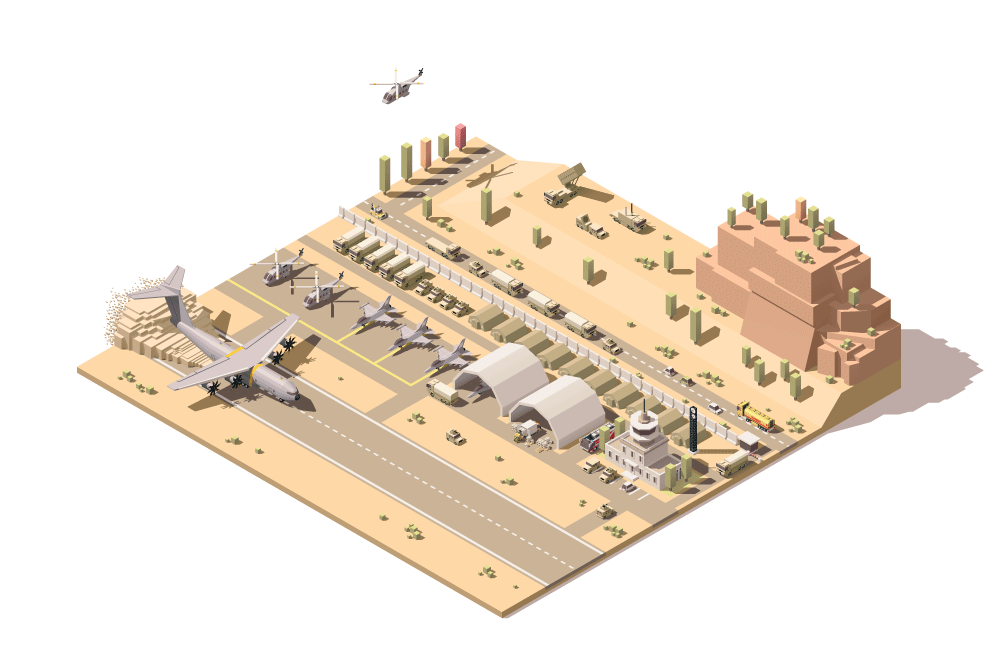
-
- Bring your own FOD prevention tools with you. FOD Containers, Magnetic Sweepers, etc.
- Take a good look at all aircraft positioning — not just yours. Are their aircraft positioned in such a way that their exhaust could be tossing objects towards your aircraft? Also consider engine maintenance run-up areas. Could they affect your aircraft?
- Be positive and diplomatic when dealing with the home base. The wrong perception of your organization could create new problems.
- What is being used for snow removal at home base or on deployment? Many locations may still use metal street sweeper brushes. These leave a trail of metal bristles behind. Consider switching to nylon brushes. Alternatively, initiate a sweeping program to ensure bristle removal.
- Develop a deployed FOD Prevention Handbook for the person managing the program at the deployment location. Basic information on this subject is available on this website. The regular Wing FOD Program Manager may not be present. Ensure the deployed FOD Program Manager understands the importance of FOD prevention and is suitably motivated.
Want to learn more? Contact us for guidance on developing your FOD prevention program!
On Base
Runway sweeping is usually carried out by mechanical sweepers. Typically, these machines use a vacuum, brushes, and sometimes magnetic media to collect debris. Most operating stations have a sweeping plan. Specifically, the plan segments the airfield into blocks. Crews attend to each block at least weekly.
In addition, runway sweeps can be requested on demand. They are worth considering after repairs, extensive aircraft work, or inclement weather. Strong winds and rain can move debris onto the airfield. Although some airfields use road sweepers, new specialized FOD sweepers are far more effective. Moreover, some equipment can clean surface areas and reach between the gaps in concrete blocks. This keeps flight operations areas scrupulously clean.
Airshows And Open Houses
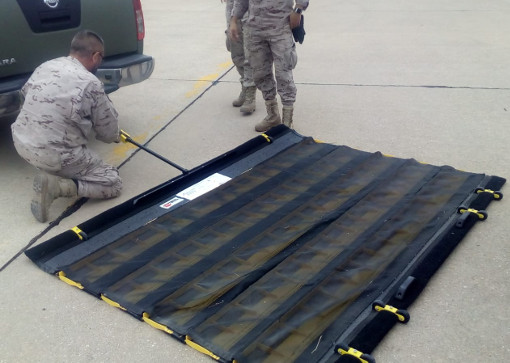
Many military airfields host open days. The military allows vast crowds onto the airfield. The airfields are transformed into fairgrounds. Typically, organizers bring in external catering and amusements to keep visitors fed and entertained. Flying displays are usually scheduled for the busiest times. Special attention is required to keep operating areas free from debris. This matters particularly when strong winds can blow litter onto the field. Hooded litter bins should be placed near the food and drink stands. They must be readily available.
At the forward edge of the crowd line, netting can prevent litter migration. Builder-style mesh or airfield repair netting works well. During the day, work teams should collect and empty litter into lidded bins or contained waste disposal areas.
Before operational flying commences, the airfield should be walked for FOD. Accordingly, everyone must participate. All litter and human-generated debris must be removed. Furthermore, aircraft used for static displays should undergo checks for loose articles. All trades and disciplines should participate.
Management Responsibility
In the military, management is sometimes overlooked when strong leadership dominates. Leaders take a dominant role. However, managers ensure that procedures are set, practiced, modified, and improved. In many areas — maintenance and logistics, for example — the leader and manager are the same person. They are often a commissioned officer or senior NCO.
For these individuals, safety is always the priority. However, it must be balanced against operational needs and cost. It is pointless having the safest aircraft if they cannot fly. Conversely, you cannot have the best launch rates at the expense of safety.
A Balancing Act
With FOD control, the manager must assess risk. They must also implement and enforce standards. Above all, they must verify that working practices remain effective. Managers often delegate these practices. However, while the role may shift, the responsibility remains.
Consequently, managers must be reactive in dealing with damage and proactive in dealing with prevention. They must commit at every level. Similarly, they must be prepared to assist as well as enforce. In my education as a young engineering officer, my mentors used to say “GOYA — Get Off Your Ar** —” and see firsthand what the problems are. Talk to the people that are at the front line where the “rubber meets the road.” After all, these are the people who execute your orders. They will provide the feedback you need. They know the how, why, what, and when, the effectiveness and the best way forward.
Writing Orders That Work
However, be assured: they will not write to you with their concerns. Equally, no matter how well an order is written, they will not follow something that is stupid or causes unnecessary hardship. The best orders are those which they help form and those that take their needs into account. The best managers understand everyone’s needs. They support the initiatives and practices that have the greatest effect.
Moreover, these managers are quick to praise. They recognize outstanding effort with award and reward. In FOD Prevention, award may be a certificate and reward maybe public recognition of having “gone that extra mile.” From my largely military perspective, the military are at the forefront of FOD prevention. However, whether the environment is commercial or military, it takes a committed team to have the best effect.
Everyone’s Responsibility
“FOD is everyone’s responsibility” is often repeated, but I often wonder how many take the saying seriously. There remains a pressing need to actively minimize debris. Specifically, report any activity that could lead to damage. Help prevent recurrences. Furthermore, each of us can help eradicate the problem. Every action helps, no matter how small. Pick it up. Talk about it. Place a poster to illustrate it. Share ideas, participate, and work together.
It is everything about being part of a team. Regardless of where we work, we all have a part to play. If we are connected with flying or operations support in any way, we can help. Even as fare-paying passengers, we have a duty of care. Do not throw litter. Do not discard debris where it can migrate into the path of an aircraft.
Think outside the boundaries of your job. Be prepared for the unexpected. Be willing to help. One person against FOD is good. Ultimately, a team effort is better. Work with the team. Build a team through which we will all benefit.