
Kimi Antonelli left the Melbourne garage at the 2026 Australian Grand Prix with a cooling fan still attached to his W17. The duct fell onto the circuit in two pieces — one at the Turn 1 braking zone, another near Turn 3. Lando Norris drove over both, sustaining front wing damage. A red flag stopped the session. FIA stewards fined Mercedes €7,500. One cooling fan. One missed step. Nearly cost the defending world champion a top-three qualifying result.
Here in America, NASCAR pit roads see a different version of the same problem. During a 2024 Cup Series race, John Hunter Nemechek’s No. 42 shed a lug nut that rolled the full length of pit road and struck Daniel Suarez’s No. 99 mid-service, nearly hitting a crew member. No penalty. No red flag. Just a loose piece of hardware migrating at speed through the most crowded corridor on the track.
That is pit lane FOD. It does not arrive from outside the venue. It originates inside the most controlled, most choreographed zone in motorsport — on both sides of the ocean.
Why Pit Stops Are a FOD Factory
The scale differs by series, but the risk is universal. In Formula 1, McLaren holds the world record at 1.80 seconds, set at the 2023 Qatar Grand Prix and matched again in 2025. Over 20 crew members change four tires in under 2.5 seconds — three technicians per corner plus jack and cooling crews. Every non-standard item attached during preparation must come off before the car exits.
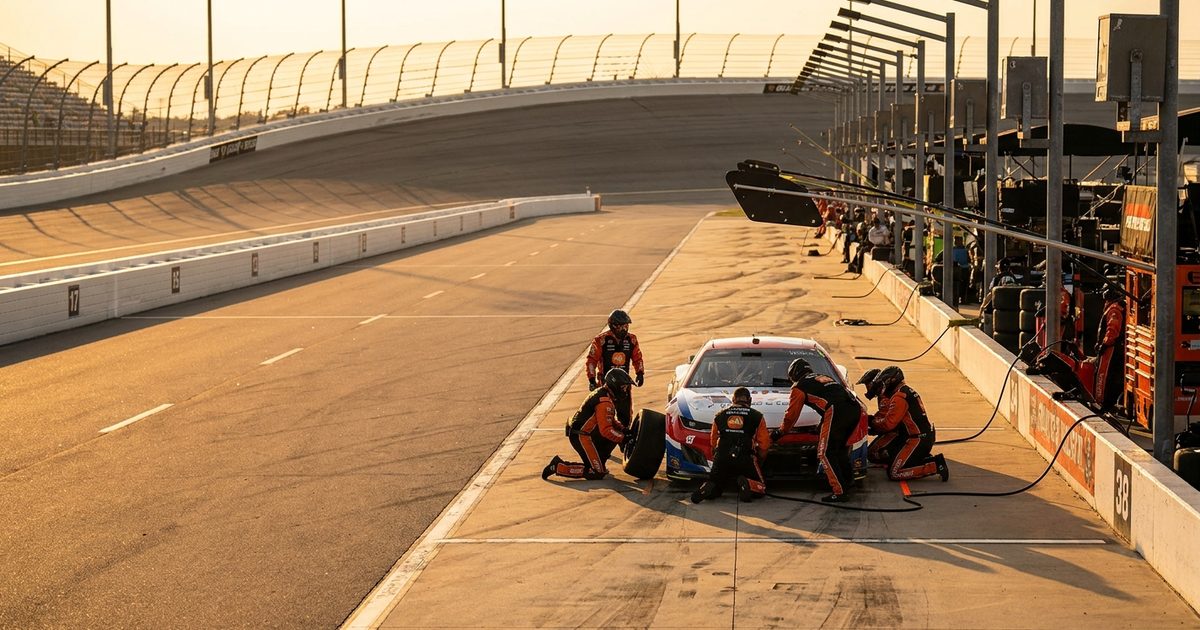
NASCAR pit stops are a different kind of intense. Five crew members handle everything over the wall — tire changes, fueling, chassis adjustments — typically in 12 to 14 seconds. Fewer hands, but more tasks per person, and the equipment list is longer: lug nuts, impact wrenches, wedge bolts, jack handles, fuel catch cans. A single dropped lug nut on pit road may seem minor until you consider that 40 cars cycle through green-flag pit stops within a handful of laps. Data shows debris cautions spike roughly 50% in the laps immediately following those pit windows.
Speed doesn’t just reward discipline. It punishes any lapse in it — whether the stop takes 2 seconds or 12.
The Hardware That Ends Up on the Racing Surface
The debris profile varies by series. In F1, wheel nuts are a well-documented culprit — Alexander Albon received a 10-second stop-and-go penalty at Imola in 2024 for an unsafe release, and Valtteri Bottas retired from Monaco in 2021 when a seized nut left debris in the lane. Carbon fiber fragments, cooling fans, valve caps, and wheel gun fittings round out the typical F1 debris list.
NASCAR pit road generates its own signature debris: lug nuts (five per wheel, twenty per stop, 800 across a full-field cycle), impact sockets, wedge adjustment wrenches, strips of bodywork tape, and fuel overflow from catch cans. IndyCar adds fuel hardware and valve caps to the mix. The materials differ, but the mechanism is identical — small objects left behind under extreme time pressure.
Common debris categories across all series include:
- Lug nuts and wheel fasteners — the single most common pit road debris item in NASCAR; also a recurring issue in F1 and IndyCar
- Cooling fans and blower ducts — clipped to brake intakes during prep; easily missed on a hurried departure
- Carbon fiber fragments — shed during contact or structural damage at road courses and street circuits
- Tools and fittings — impact sockets, wedge wrenches, jack components dropped under the car
- Tape, trim strips, and aero adjustments — applied in the garage, capable of peeling under heat and vibration at speed
Each item is small. Each one, at 190+ mph on a superspeedway or 200+ mph through an F1 braking zone, becomes a projectile. FOD causes damage across industries, not just motorsport. Our overview of what FOD is and why it matters covers the full picture.
The Anatomy of a Pit Lane FOD Event
The Antonelli incident fits a familiar FOD pattern: an exceptional workload created distraction, and a standard procedure got skipped. Mercedes was managing the aftermath of Antonelli’s heavy FP3 crash. The cooling fans went unnoticed. No alarm sounded. No sensor flagged it.
The Nemechek lug nut incident shows the NASCAR version of the same failure mode. In a series where five crew members handle the full stop, a single dropped fastener doesn’t trigger a penalty — it simply migrates. With 40 cars pitting within a narrow window, the probability of contact compounds with every lap.
Recklessness is rarely the cause in either series. The real driver is complexity colliding with time pressure. Whether it’s 20 crew in 2.5 seconds or 5 crew in 12, any item outside the core service sequence is a debris candidate. Debris at racing speed punches through diffusers, tires, and brake ducts. In open-wheel categories, loose hardware can be catastrophic. On ovals, the banking channels debris toward the racing line. See our guide to motor speedway safety and FOD prevention for a deeper look at race venue risks.

Prevention: What Works at Speed
Both governing bodies have tightened pit lane enforcement. The FIA introduced stricter unsafe release protocols for 2025. NASCAR has expanded its use of pit road cameras and post-race penalties for equipment violations. Technology helps at the pit box — thermal imaging, sensor-equipped wheel guns, and electronic torque verification all reduce the chance of a missed fastener.
But discipline and technology only address the pit box itself. The racing surface — the pit straight, the exit lane, the front stretch, the oval banking — still requires physical intervention. That means sweeping. A friction sweeper can cover a 1.5-mile oval in minutes, fitting cleanly into stage breaks, caution laps, or between sessions. The FOD-Razor® handles exactly this environment. It removes metallic debris from racing surfaces without disrupting the track preparation schedule.
Prevention at a racetrack operates in layers. Checklists and protocols govern the garage. Sensor systems monitor the car. And surface sweeping clears what inevitably makes it through both. No single layer is sufficient on its own.
Key Takeaways
- Pit lane FOD is a cross-series problem — F1 cooling fans in Melbourne, loose lug nuts on NASCAR pit road, fuel hardware in IndyCar. The source is always the operation itself.
- NASCAR’s green-flag pit windows create a concentrated debris migration event: 40 cars cycling through in a handful of laps, with debris cautions spiking roughly 50% immediately afterward.
- Common debris types span lug nuts, cooling equipment, carbon fiber fragments, tools, and tape — confirmed by real incidents across F1, NASCAR, and IndyCar in recent seasons.
- Both the FIA and NASCAR have tightened pit lane enforcement, but the racing surface itself still requires active sweeping between sessions and during caution periods.
- A layered approach — protocols, technology, and physical debris removal — is the most reliable way to manage pit lane FOD at any motorsport venue.
Protect Your Racing Facility
FOD on a racing surface is a recurring operational reality. If you manage a circuit or motorsport venue, FOD Control Corporation can help. We build debris management programs that work at race pace.
Contact our team to discuss your facility’s needs. Or download our free FOD Prevention Booklet to get started.