
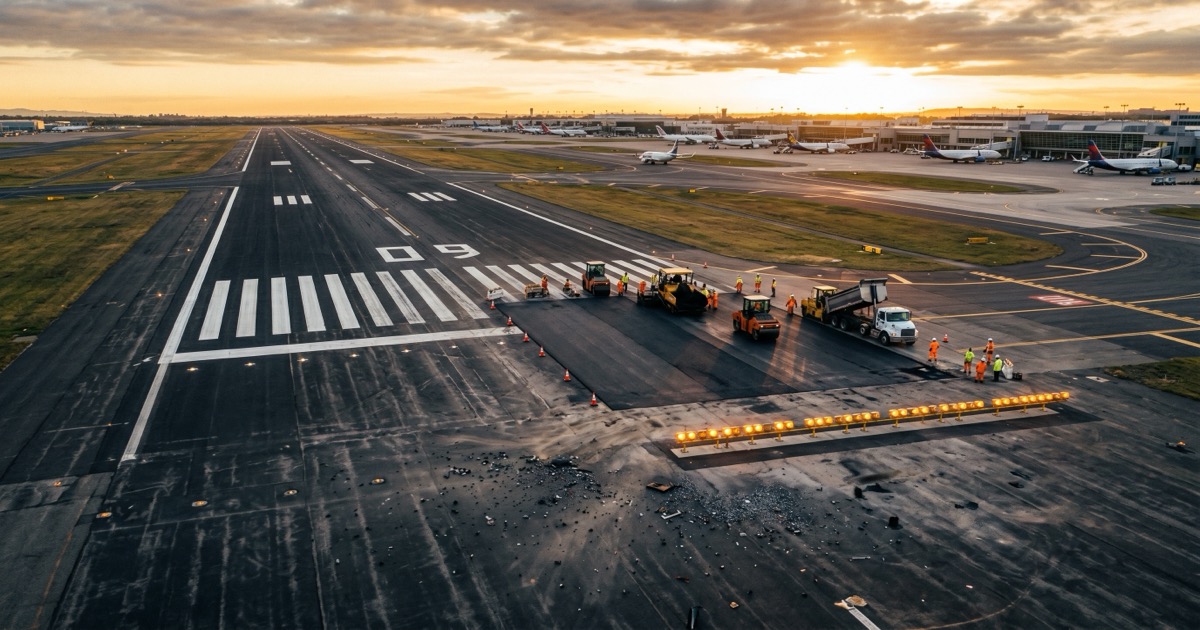
Every airport has a FOD program. Daily inspections. Scheduled sweeps. Training for ground crews. But there is a gap that standard programs consistently miss — and it opens every time a pavement crew packs up and leaves a runway or taxiway.
Runway pavement repairs are a peak-risk FOD event. Milling, joint sealing, crack repair, and overlay projects all leave behind loose aggregate, sealant chunks, milling fines, and tool fragments that routine FOD walks don’t reliably catch. Understanding what FOD is and how it behaves after construction is one of the most underappreciated challenges in airfield safety management today. Runway pavement repair FOD — debris generated or displaced by pavement work — represents a distinct hazard category that deserves its own response protocol.
The Debris That Stays Behind
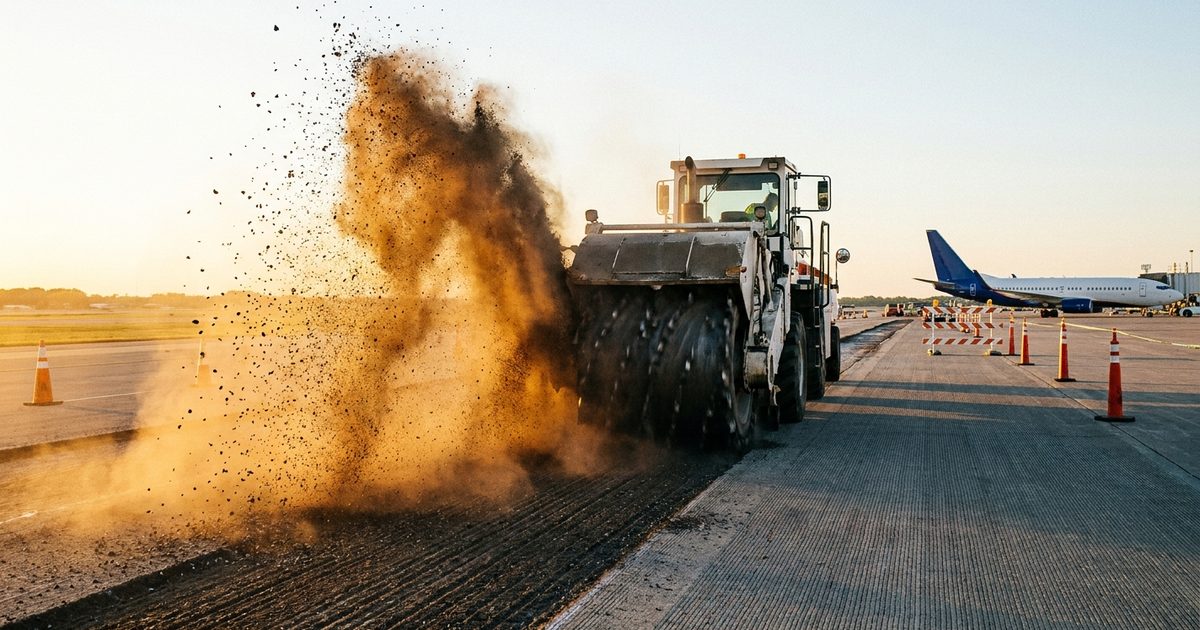
Pavement repair operations generate several distinct categories of debris. Milling — the process of grinding down existing pavement before overlay — produces loose asphalt chips and fine particulates. These particles don’t stay neatly within the work zone. Construction vehicle tires pick them up and track them across taxiways. Meanwhile, jet blast from aircraft on adjacent pavement can scatter lightweight fines hundreds of feet from the source.
Joint sealing creates a different hazard. Rubberized sealant extruded from a failed or over-applied joint can cure, harden, and break loose as a solid chunk. Standard FOD walks frequently miss these pieces because they blend visually with weathered pavement. Partial-depth patching is another source: patching compounds, curing agents, and form materials can all leave fragments that migrate toward aircraft movement areas.
According to FAA Advisory Circular 150/5380-6C, moderately and severely spalled cracks wider than one-quarter inch represent “definite FOD potential” — and that assessment applies before any repair work begins. Construction activities amplify this baseline risk significantly.
Why Standard FOD Programs Come Up Short
Most airport FOD programs are designed around steady-state operations — routine sweeps of runways, taxiways, and ramps at regular intervals. These programs work well for catching the random bolt, safety wire, or piece of aircraft hardware that finds its way onto an active surface.
However, they are not designed for the construction closeout window. When a pavement crew demobilizes — even following a compliant “clean-as-you-go” protocol as required by FAA AC 150/5210-24A — a window opens between final crew departure and return of aircraft operations where residual debris is present but undetected. Standard FOD walks are often inconsistent at finding loose aggregate or milling fines on rough or freshly textured surfaces, particularly in low-light conditions or on textured pavement surfaces.
Industry data places the annual cost of FOD incidents at approximately $4 billion in direct damages globally, with total costs — accounting for delays, cancellations, unscheduled maintenance, and liability — reaching an estimated $22.7 billion (FAA, 2023). Runway pavement repair FOD consistently ranks among the primary source categories, yet post-construction debris often goes uncounted in these figures because airports categorize it under “construction incidents” rather than standard FOD reporting channels.
The Protocol Gap: Construction Closeout to Return-to-Service
The highest-risk window for runway pavement repair FOD is the transition period between construction zone closeout and return of aircraft operations. Even with daily inspections mandated by airport construction safety plans, this handoff is where residual debris most commonly survives detection.
Several factors compound the risk. Construction crews naturally focus on their immediate work zone — they may not track how far aggregate has migrated via vehicle traffic or wind. FOD walks during this window are often performed by the same personnel who have been working the site, creating a confirmation bias toward “clean.” Furthermore, compressed timelines — runway closures are expensive, and airports push to reopen fast — create real pressure to abbreviate post-construction inspection protocols.
For airports getting started with aviation FOD prevention, the pavement repair window is a critical place to begin: it demands a dedicated response protocol, not reliance on the standard sweeping program.
What a Smart Post-Repair Protocol Looks Like
Addressing runway pavement repair FOD requires a layered approach that goes beyond a human walk-down. Airports with the most effective programs treat each pavement repair project as a triggering event for an elevated FOD response — not a continuation of normal operations.
The core elements of an effective post-repair protocol include:
- Pre-reopening friction sweep: A mechanical sweep of the repaired surface and adjacent pavement before returning to aircraft operations. Human FOD walks can miss loose particles on rough or textured surfaces — a mechanical friction sweep provides consistent coverage regardless of surface condition.
- Buffer zone sweeping: Sweeping should extend well beyond the repair boundary. Aggregate travels. Milling fines tracked by construction vehicles can end up 500 feet or more from the work zone.
- Vehicle crossing controls: Any vehicle crossing from a construction zone to an operational aircraft movement area should receive a tire inspection. AC 150/5210-24A requires this step, but enforcement is inconsistent across airports.
- Post-seal inspection timing: Joint sealing operations should be followed by a 24- to 48-hour monitoring window before the sealed area returns to heavy aircraft traffic, with a dedicated inspection immediately before reopening.
- Construction FOD reporting: Debris found in post-construction sweeps should be logged through the airport’s standard FOD reporting system — not quietly disposed of. That data informs future protocols and establishes a baseline for risk trending.
Airports that deploy the FOD-Razor® airport friction sweeper as part of their post-repair protocol report dramatically faster debris clearance compared to manual walks. The FOD-Razor’s flat, low-profile friction mats drag directly against the pavement surface, capturing loose aggregate, milling fines, and surface debris most associated with runway pavement repair FOD — small particles that are difficult to spot visually on textured pavement. Simply tow it behind any ground support vehicle; no specialized operator is required.
Key Takeaways
- Runway pavement repairs — milling, joint sealing, patching, and overlay — create peak-risk FOD windows that fall outside most airports’ standard sweeping cadences.
- Loose aggregate, milling fines, sealant chunks, and construction material fragments migrate via vehicle traffic and jet blast, often well beyond the repair boundary.
- FAA AC 150/5210-24A requires FOD prevention plans for construction near aircraft movement areas, but the transition from construction closeout to return-to-service is the most common protocol gap.
- Post-construction FOD incidents are frequently under-reported because airports categorize them as “construction events” rather than standard FOD — obscuring the true risk profile of pavement repair work.
- Effective response requires a pre-reopening mechanical sweep of the repair zone and buffer area — not reliance on a human walk-down that can miss loose debris on textured or freshly repaired pavement.
Close the Gap Before the Next Repair Project
If your airport’s FOD program treats pavement repairs like any other operational day, there is a gap worth closing. A mechanical sweeping protocol tied to construction closeout events is one of the most cost-effective safety improvements an airfield operations team can implement.
Contact the FOD Control team to learn how the FOD-Razor® integrates into a post-repair clearance protocol — or download our free FOD Prevention Booklet for a comprehensive framework you can put into action immediately.