
FOD is an important safety and quality control concept in aviation, aerospace, manufacturing, motorsport, shipping, military and similar environments. In these environments, small debris, loose objects, wildlife and even stray humans have the potential to cause:
- damage to manufactured equipment;
- injury to employees, visitors or passengers;
- production delays or safety violations.
More specifically, depending upon the context, there are two interrelated “FOD” (or F.O.D.) meanings:
- Foreign Object Debris
- Foreign Object Damage
Efforts to prevent Foreign Object Damage are collectively referred to as FOD Prevention Programs or FOE (F.O.E.) Foreign Object Elimination.
Understanding FOD is the first step toward preventing it. This guide covers what FOD is, where it comes from, what it costs, how to fight it and where to find authoritative resources for your specific industry. Whether you manage an airport, a military base, a racetrack or a manufacturing facility, the principles of FOD prevention apply to you.
What is Foreign Object Debris?
Foreign Object Debris is any object, particle, substance or agent that is not where it is supposed to be. In aviation or a similar environment, it could create a hazard to aircraft, equipment, cargo or personnel. Similarly, in manufacturing, it could contaminate a product or injure workers.
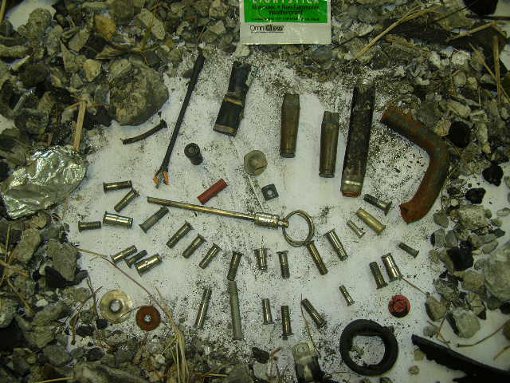
Foreign object debris collected at Kadena Air Base, Japan, during a FOD Walk.
Foreign object debris examples include:
- Tools, parts and loose hardware
- Building materials
- Paper, paper clips, pens, coins and badges
- Fragments of broken pavement
- Trash, food wrappers and beverage containers
- Rocks, sand and loose vegetation
- Baggage tags and pieces of luggage
- Hats, rags and gloves
- Birds, wildlife and stray animals
- Volcanic ash
- Humans
Surprisingly, even people can become debris if they are in the wrong place at the wrong time. There are documented instances of humans getting caught in dangerous situations.
How Does FOD End Up Where It Shouldn’t Be?
FOD does not appear out of nowhere. Instead, it arrives through predictable channels. Understanding these sources is the first step toward controlling them.
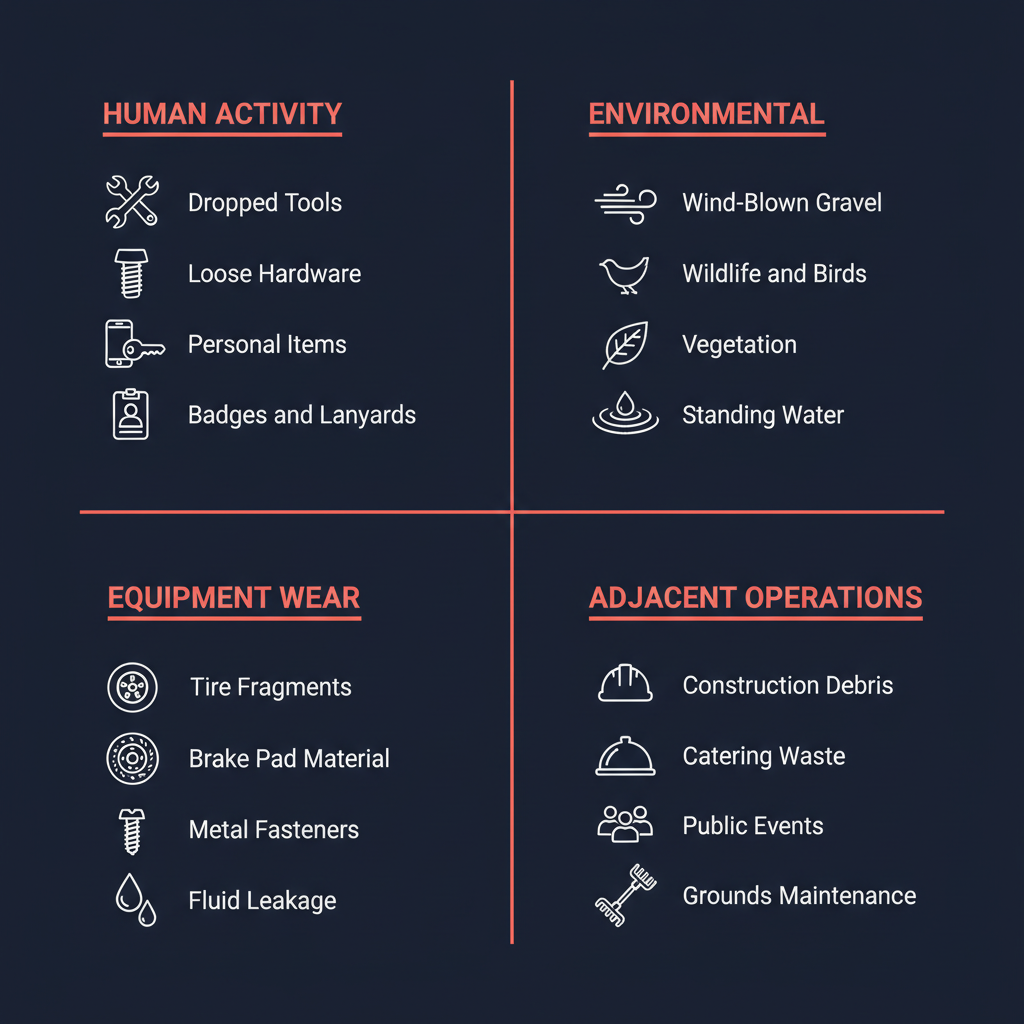
Human Activity
People are the most common source of FOD. Dropped tools, forgotten hardware, personal items left behind and clothing that sheds fibers all introduce foreign objects into controlled environments. For example, in aviation, a mechanic’s forgotten socket wrench on a wing surface can become lethal debris during flight. Likewise, on a racetrack, a lug nut dropped during a pit stop can shred a tire two laps later.
Environmental Factors
For instance, wind carries sand, gravel, leaves and other natural debris onto runways, tracks and factory floors. Additionally, rain washes material from adjacent areas onto paved surfaces. Meanwhile, temperature changes cause pavement to expand and contract, creating cracks that generate loose chunks. Wildlife — from birds on a runway to rodents in a warehouse — adds another unpredictable dimension.
Equipment Wear and Deterioration
Additionally, machinery generates its own FOD over time. For example, rubber tires shed material. Brake pads produce dust and fragments. Over time, pavement surfaces deteriorate under repeated stress. Vehicle bodywork loosens from vibration. Furthermore, even new equipment can shed packaging materials, protective films and shipping hardware if not properly inspected before use.
Adjacent Operations
For example, construction near an active runway, maintenance work alongside a production line or landscaping next to a racetrack all generate debris that can migrate into critical areas. Therefore, managing the boundaries between operations is essential to effective FOD control.
What is Foreign Object Damage?
Foreign Object Damage is damage caused by debris that compromises the quality, functionality or economic value of a manufactured item. As a result, a piece of FOD at the wrong place at the wrong time can:
- Shred fan blades when sucked into a turbojet
- Blow out tires at high speeds
- Damage delicate components when trapped inside equipment housing
- Freeze control mechanisms when lodged next to levers and handles
FOD also poses direct risks to human safety. For instance, ground crew members have been struck by debris ejected from jet engines. Factory workers have been injured by contaminated machinery. Spectators at motorsport events have been hit by debris launched from the track surface.
Moreover, in military environments, FOD can affect national security. A grounded fighter squadron means reduced air defense capability. A damaged helicopter means a delayed rescue mission. The stakes go far beyond dollars.
Serious foreign object damage examples include:
- The July 2000 crash of Air France Flight 4590 near Paris, France. A titanium strip had fallen off another airliner’s engine cowl, landing on the runway. Minutes later, it shattered one of 4590’s tires during takeoff, rupturing a fuel tank. 113 people died. Litigation and criminal prosecution lasted for years.
- The January 2009 crash of US Airways Flight 1549 into the Hudson River in New York. Shortly after takeoff, a flock of Canadian Geese struck the airliner, shutting down both engines. The pilot successfully ditched the plane into the river. There were five serious injuries but, miraculously, no fatalities.
The Cost of FOD
FOD is not just a safety issue — it is a massive financial burden across every industry it touches.
Aviation
The civilian aviation sector loses an estimated $4 billion to $13 billion annually to FOD. Specifically, these costs include damaged equipment, flight delays, reduced efficiency, litigation and related expenses. A single FOD incident on a runway can ground aircraft, delay hundreds of flights and expose airport operators to significant liability.
The Air France Flight 4590 disaster alone resulted in hundreds of millions of dollars in settlements, legal fees and regulatory changes. Remarkably, that tragedy started with one small strip of metal on a runway.
Military
The U.S. Air Force estimated that FOD cost the service $240 million over a ten-year period from 1995 to 2004. However, that figure only covers direct equipment damage. It does not account for lost mission readiness, training delays or the operational cost of grounded aircraft.
Every branch of the U.S. military maintains formal FOD prevention programs. The stakes are too high not to.
Manufacturing
Similarly, in manufacturing, FOD contamination leads to product defects, warranty claims, production shutdowns and regulatory penalties. Indeed, a single foreign object inside an assembled product can trigger a recall costing millions.
Motorsport
On the racetrack, for instance, FOD causes tire failures, vehicle damage, race delays and potential injuries to drivers, crew and spectators. A bolt on a racing surface can shred a tire at 180 mph. The resulting wreck can destroy a car worth tens of thousands to millions of dollars.
The Hidden Costs
However, direct damage is only part of the equation. FOD incidents also carry hidden costs that multiply fast:
- Downtime. For example, a FOD strike on a runway can shut down operations for hours. Every minute of delay has a cascading financial impact on airlines, passengers and cargo.
- Investigation and reporting. In addition, serious FOD incidents trigger mandatory investigations. Staff time, documentation and regulatory reporting all carry costs.
- Insurance premiums. As a result, facilities with FOD incident histories face higher premiums. Insurers increasingly require documented prevention programs.
- Litigation. FOD-related injuries or fatalities can result in lawsuits lasting years. Legal fees alone can reach millions before any settlement.
- Reputation. Finally, an airport, track or factory known for FOD problems loses business. Customers, tenants and partners choose safer alternatives.
Across every sector, the math is the same: prevention costs a fraction of what FOD incidents cost.
Who Uses the Term?
The acronym “FOD” is most often used in aviation and aerospace. However, other industries may use terms like “contamination” when referring to similar concepts.
Alternative FOD definitions you’ll likely encounter include:
- Foreign Object Debris: A substance, debris or article alien to a vehicle or system which would potentially cause damage.
- Foreign Object Damage: Damage attributed to a foreign object that can be expressed in physical or economic terms. It may or may not degrade the product’s required safety or performance characteristics.
Regardless of terminology, FOD is a serious concern in any environment where safety and quality require that everything be in its proper place.
FOD Prevention Methods
Effective FOD prevention combines people, processes and equipment. No single tool or technique eliminates FOD on its own. Instead, the best programs layer multiple approaches.
FOD Walks

Many people who have served in the Military have participated in a FOD Walk.
A FOD walk is a systematic, shoulder-to-shoulder inspection of a work area. Personnel walk in a line across a runway, ramp, track or factory floor. Then, they pick up every foreign object they find. FOD walks are standard practice on military flight lines and increasingly common at civilian airports and motor speedways.
Sweeping and Cleaning Programs
Mechanical sweeping is the backbone of FOD removal. Equipment ranges from simple friction mat sweepers like the FOD-Razor® to vacuum trucks and rotary brush machines. Above all, consistency is key — a scheduled sweeping program removes debris before it causes damage.
In particular, friction mat sweepers like the FOD-Razor® are effective because they are mechanically simple. No engines, no electronics, no fuel. They tow behind any vehicle and collect debris directly from the surface. As a result, they are reliable in harsh environments where complex machinery can fail.
Tool and Parts Accountability
In particular, lost tools are among the most dangerous forms of FOD. Therefore, tool control programs require that every tool be accounted for before and after each job. Shadow boards, kitting trays and electronic tracking systems help ensure nothing gets left behind.
Training and Culture
The most important FOD prevention tool is awareness. When every person in an organization understands what FOD is and why it matters, prevention becomes second nature.
Effective training programs include:
- New employee orientation. Every new hire should learn FOD basics on day one. This applies to all staff, not just those on the flight line or factory floor.
- Regular refresher training. Annual or semi-annual sessions keep FOD awareness sharp. Use real incidents and near-misses to keep the content relevant.
- Visual reminders. Signage, posters and FOD-free zone markers reinforce the message daily. The best programs make FOD awareness impossible to ignore.
- Recognition programs. Rewarding employees who identify and report FOD hazards encourages participation. A small incentive program can yield major results.
Ultimately, culture matters more than any single tool or procedure. When leadership takes FOD seriously, the entire organization follows.
Formal FOD Prevention Programs
A comprehensive FOD prevention program ties all of these methods together. It assigns accountability, documents procedures, tracks results and drives continuous improvement. Learn more about setting up a company FOD program.
Equipment Used to Combat FOD
- FOD-Razor® airfield and facility sweepers — tow-behind friction mat sweepers that clean runways, taxiways, ramps, racetracks and parking areas of small debris.
- Disposal containers and FOD collection bags — for safe disposal and OSHA-compliant temporary storage of found debris.
- Tool and parts kitting — allows technicians to track small objects during on-site jobs.
- Specially-designed clothing and footwear — prevents ripping, tearing, snagging and carried debris in FOD-sensitive areas.
- Aircraft and wheel covers — protect equipment from rain, wind, dust and other environmental hazards.
- Automated detection systems — radar- or camera-based units that scan runways for debris or wildlife.
- Magnetic sweepers and bars — capture ferrous metal debris that other tools may miss. Often mounted on vehicles or towed behind primary sweepers.
- Prevention signage and zone markers — visual reminders that designate controlled areas and reinforce awareness.
FOD by Industry
FOD affects every industry where equipment, vehicles or people operate on shared surfaces. Although the specifics vary, the principles are universal.
Aviation
Airports face FOD from pavement fragments, wildlife, luggage hardware, maintenance debris and weather events. Consequently, every surface — runways, taxiways, ramps, aprons and gate areas — is a potential collection point for hazardous debris. Runways, taxiways, ramps and aprons all require regular inspection and sweeping. Because of these risks, the FAA requires certificated airports to maintain FOD prevention programs. As a result, the consequences range from tire blowouts during takeoff to catastrophic engine failures. Read our complete guide: FOD Prevention in Aviation: Getting Started.
Military
Military flight lines demand the highest level of FOD discipline in any industry. Even a single piece of debris ingested by a fighter jet engine can destroy millions of dollars in equipment. As a result, every branch of the U.S. military conducts regular FOD walks. Formal prevention programs are mandatory, not optional. The consequences of failure can extend beyond dollars to national security. Read more: The Essential Guide to Military FOD Prevention.
Motorsport
Racetracks contend with tire rubber, hardware from pit stops, cracked pavement and vehicle bodywork fragments. At racing speeds, even small debris can cause catastrophic tire failures and multi-car crashes. Consequently, track operators must sweep before, between and after sessions. Pit lane debris is a particularly common source — lug nuts, tape fragments and bodywork pieces escape during the chaos of competitive pit stops. Read more: Motor Speedway Safety and FOD Prevention.
Manufacturing and Warehousing
Factory floors, clean rooms and assembly lines are vulnerable to contamination from tools, packaging materials, personal items and process byproducts. FOD in a manufactured product can trigger recalls costing millions, warranty claims and regulatory action. In aerospace manufacturing, a single forgotten tool inside an aircraft assembly can ground an entire fleet. In addition, clean room environments face additional challenges from microscopic contamination that can ruin precision components. Read more: Controlling FOD in a Manufacturing Facility.
- View our infographic on prevention processes in factory and warehouse settings.
- Learn more about cleanrooms in this white paper.
Sources for More Information
Advisory Circulars
The U.S. Federal Aviation Administration deals with FOD prevention and control standards at civilian airports:
- AC 150/5210-24, Airport Foreign Object Debris (FOD) Management — FOD program guidance and equipment specifications for airport managers.
- Circular 150/5220-24, Foreign Object Debris Detection Equipment — covers automated systems that use radar and imaging to scan runways.
- For self-inspections, see AC 150/5200-18, Airport Safety Self-inspection.
- Risk management is addressed in AC 150/5200-37, Introduction to Safety Management Systems (SMS) for Airport Operators.
- Pavement maintenance is covered by AC 150/5380-6, Guidelines and Procedures for Maintenance of Airport Pavements.
NAS 412
NAS 412 is an industry standard issued by the Aerospace Industries Association (AIA). Specifically, it establishes general practices and standard terms for FOD prevention in aerospace products and operating environments. Furthermore, a FOD Advisory Board composed of AIA and other public/private sector representatives helps manage and update the standard.
AS9146
AS9146 is a standard published by the Americas Aerospace Quality Standards Committee (AAQSC). It defines FOD Prevention Program requirements for organizations that design, develop and provide aviation, space and defense products. The AAQSC is affiliated with the Americas Aerospace Quality Group (AAQG), a member of the SAE Industry Technologies Consortia and a sector within the International Aerospace Quality Group (IAQG).
Trying to decide which type of sweeper is best for your facility? Read our airport sweeper technology comparison or complete this FOD sweeper assessment form, and we’ll be happy to make recommendations.
Have Questions? Want to learn more? Contact us for help in setting up your FOD prevention program.